† 16 October 2026 • 6:18 PM • Siyambalangamuwa
More Than an Elephant. A Living Heritage.
The life and legacy of Kavantissa († 16 October 2026), one of Sri Lanka’s remarkable wild tuskers.

First-Hand Field Account
R.M.J. Bandara
As told by R.M.J. Bandara — environmental activist and lifelong guardian of the Galgamuwa tuskers.

I. The Shadow of November 2010
To understand Kavantissa, you must first know the tragedy that gave him to us.
For years, the scrub jungles and water tanks of Galgamuwa and Usgala Siyambalangamuwa belonged to one undisputed king: the beloved Siyambalangamuwa Tusker, whom wildlife records called Parakrama. He was a living monument of the Vanni. But on the night of November 21, 2010, tragedy struck. Near the spill of Mahagalgamuwa tank, a man was fatally attacked by a wild elephant. That same night, completely oblivious, the Siyambalangamuwa Tusker had crossed the tank and wandered into a home garden in Ganedivulwewa, several villages away.
What followed still haunts me with bitter disbelief.
By sunrise the next morning, an elephant capture unit had already descended upon the area. The formal inquest into the villager’s death hadn’t even taken place. No magistrate or investigating officer had inspected the ground. Yet, within less than twenty-four hours, an official capture warrant had been dispatched for the tusker. The blameless giant—who had never harmed a soul—was condemned without a trial.
Both the rogue bull that struck the villager and the gentle tusker had simply crossed Mahagalgamuwa tank through the same waters. Following the footsteps leading out of the water, the wildlife team tracked the tusker past the road by Makalanegama school. Around eleven that morning, beneath the shade of a Bo tree near the tank bund, they shot the tranquilizer dart into his flesh.
Startled and burning with the chemical fire, the giant bolted. He covered a mile and a half along the reservoir embankment, passed the Makalanegama elders' home, crossed the Galgamuwa–Ehetuwewa road in broad daylight, and headed desperately for the sanctuary of Siyambalangamuwa tank. But the drug took hold. Disoriented, he blundered into a loose, sandy plot planted with peanuts. His colossal limbs sank deep into the ploughed earth. As he struggled helplessly, the capture ropes were looped and knotted tight around his legs.
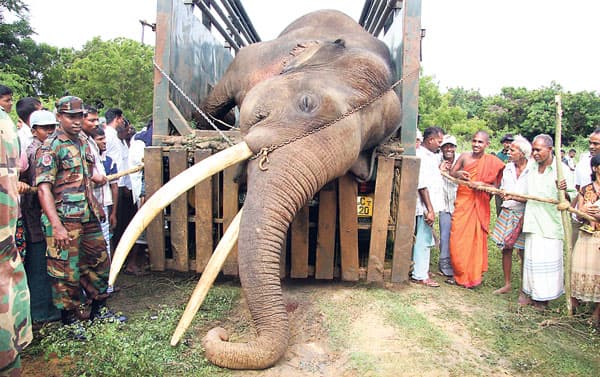
The next day, November 23, they forced him onto the bed of an iron lorry. When I and the local people pleaded with the officials to tell us where they were transporting him, nobody answered. When they loaded him, one of his sweeping tusks struck the wooden railing, splintering off a small piece of plank, but inside that iron pen, there wasn’t enough space for him to even shift a foot.
Disaster met them on the road. Near Thambuttegama, the heavily sedated giant collapsed inside the suffocating truck bed, pinned and jammed against the sides. In a blind panic, the crew turned the lorry around and raced back to Siyambalangamuwa tank. By 10:30 that night, when the engine cut out on the bund, the great heartbeat of the wilderness had stopped.
The morning after, following hurried religious rites, wildlife authorities took saws and severed his head at the neck to claim his ivory for state vaults, burying only his mutilated body in the red clay.


II. The Five Strides of an Unspoken Oath
That hasty burial opened the gates to an unnatural nightmare.
The villagers living beneath the Usgala bund had never experienced terror like this before. In all those years, herds rarely disturbed the settlement; solitary bulls might have drifted through now and then, but there had never been wrath. Yet the very night the tusker was put in the ground, sheer terror descended upon the community.
Herds plunged across the water, screaming into the darkness with roars of unearthly mourning that chilled the blood. Until sunrise, they tore through home gardens, uprooting trees, shattering roadside branches, and cleaving sacred margosa trees clean in half. All night long, the earth shook beneath their grieving wrath. Only when the morning light cracked the horizon would they retreat into the silent water. For days, the reservoir was eerily quiet by daylight and a screaming theater of grief by night.
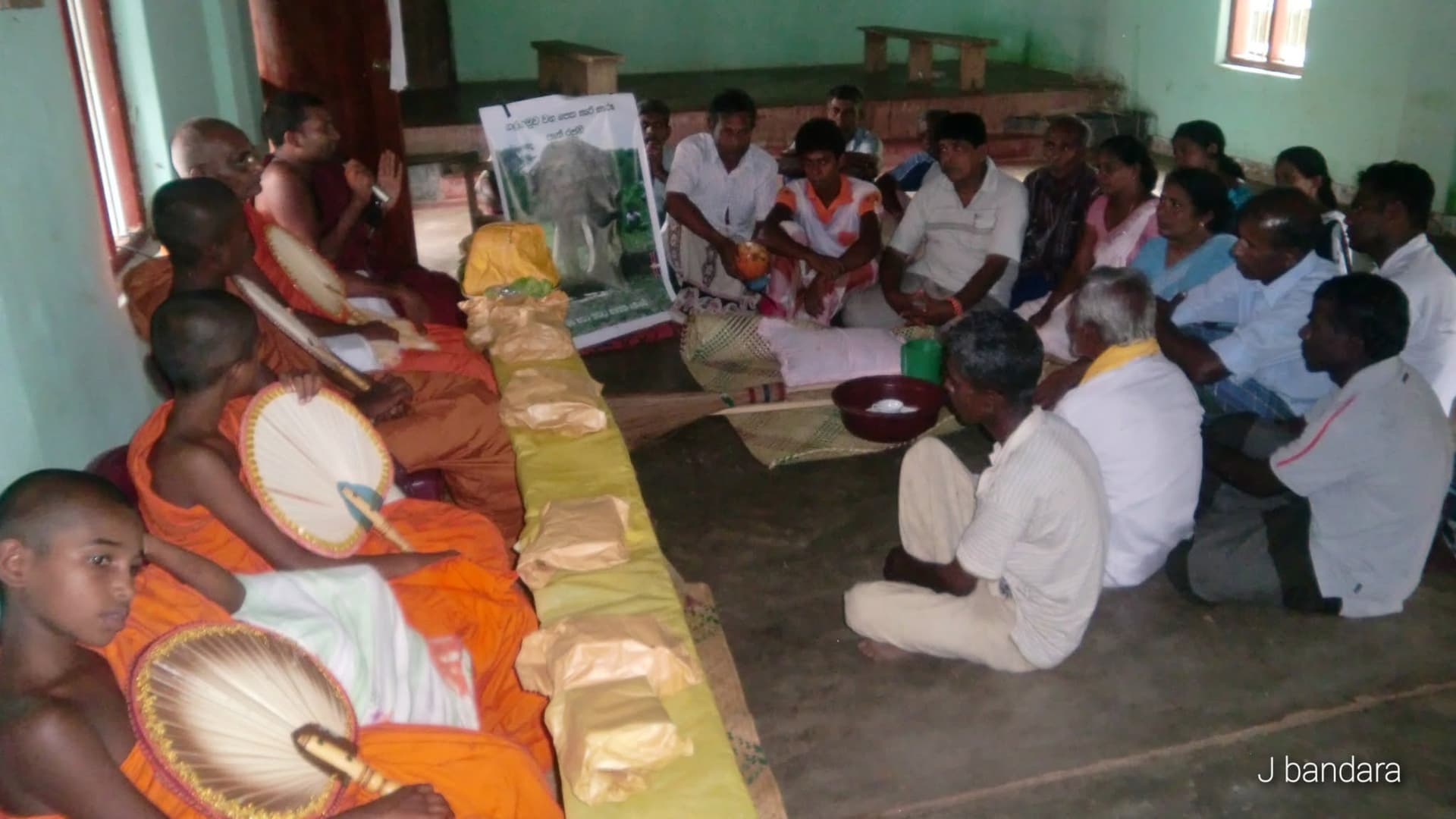
Desperate to restore peace to both the restless forest and their terrified community, the villagers came together to organize an almsgiving.
On the morning of November 29, the day of the ceremony, I went down to the fresh burial mound with the villagers to help hang sacred young coconut fronds (gok-kola) around the grave. What I witnessed stopped my heart.
Circling the freshly turned dirt were the unmistakable, elongated pad-prints of a massive, solitary tusker. In front of the mound, pressed hard into the earth, was the rounded impression of a colossal forehead—the kumbasthala. And flanking that mark were two deep craters gouged straight into the soil where a pair of great tusks had driven reverently into the ground.
Trembling with awe, I kicked off my rubber slippers. Walking bare-heeled between the two tusk holes, I measured the distance stride by stride.
One. Two. Three. Four. Five. — Exactly five paces wide.
Who was this ghost of the night who had walked out of the forest to bow his brow and sink his ivory beside our fallen king? The question burned in my chest for months.
Then came the answer. Months later, standing near the spill of Usgala Siyambalangamuwa tank on the Diyawara village side—an area I monitored constantly—I froze. A mammoth tusker stepped out of the scrub jungle. As he neared the reservoir, just paces before the water met his feet, he lowered his colossal head and drove his tusks down into the bank’s firm clay—sinking them more than three feet deep into the earth.
III. The Sovereign of Galgamuwa
For the next sixteen years, Kavantissa became the heart of our conservation efforts, the pride of the North-Western province, and my life’s quiet obsession.
He stood taller than almost any wild tusker left on the island. His ivory was a work of evolutionary art—thick at the base, curving outward and sweeping forward with a regal symmetry that made him look like he had stepped off the ancient stone carvings of Anuradhapura.
Yet what set Kavantissa apart from every other bull in the dry zone was his serene, sovereign composure. In an era where human-elephant conflict exploded across the landscape—where traditional migratory corridors were sliced apart by high-voltage electric fences, crop-guard trenches, and cruel explosive baits (hakka patas)—Kavantissa chose peace.
He was never a rogue. He never held the blind, volatile terror born of fear. When farmers kept lonely vigils high in wooden watch huts (pela) along the paddy perimeters, Kavantissa would emerge like a gray hill bathed in silver moonlight. He would stand at the tree line, ears fanning slowly, tolerating the shouting of men, the blinding beams of torchlights, and the crackle of thunderflashes without breaking into a charge. He understood the people. He would quietly bypass domestic dwellings, preferring to wade shoulder-deep into the lotus-covered shallows of Usgala, grazing peacefully on succulent water weeds until dawn.
I experienced this gentle nature firsthand in my own yard. My home is located close to the Mahagalgamuwa tank—right in the corridor that lies between the Usgala Siyambalangamuwa tank and the Palukadawala tank, an ancestral route that Kavantissa and the other wild herds traveled back and forth throughout the seasons. One night, Kavantissa drifted out of the darkness and stepped directly into my home garden. To look out into the quiet yard and see that towering colossus standing beneath the canopy of trees, his immense tusks gleaming in the dim light, was breathtaking. There was no fury in him, no destructive malice; he inspected the grounds with quiet, majestic composure, touched nothing of consequence, and peacefully continued his nocturnal journey along the ancient elephant trail.
Whenever he went into musth, or whenever gunshots echoed across the borderlands, my fellow activists and I would hold our breath, tracking his footprints, checking his majestic ivory, and thanking the gods each time he re-emerged from the thorn scrub unscathed. To stand on the bund of Usgala at sunset and watch Kavantissa wade through blooming lotuses was to witness the soul of Sri Lanka’s wild heritage, unbroken and free.
IV. The Tragic Sunset (October 2026)
Even the gentlest sovereign cannot survive a landscape that is slowly running out of mercy.
In late September 2026, word reached me that tore my soul apart: Kavantissa was in deep distress near the farmland fringes of Thambuttegama and Galgamuwa. When we rushed to the field, our worst fears were confirmed. A heavy gunshot wound—fired from the shadows of a farm boundary—had shattered the flesh of his front right leg.
For nearly a month, an agonizing battle played out in the scrub. Dedicated wildlife veterinarians, field officers, and trackers followed him relentlessly on foot, treating the wound with long-range antibiotic darts, anti-inflammatories, and pain management. We watched our king fight with everything he had. The deep flesh wound began to clean out, showing faint promises of recovery.
Yet, the prolonged trauma, the searing pain, and the scorching October heat proved too cruel. Unable to feed properly or reach open water, his towering body began to wither from internal exhaustion and severe dehydration.
On the morning of Friday, October 16, 2026, the titan could walk no farther. He collapsed in a quiet paddy field in his home domain of Siyambalangamuwa—scarcely two kilometers from where veterinarians had administered treatment only hours earlier.
Through the sweltering heat of the afternoon, the veterinary teams refused to surrender. They pumped dozens of liters of saline, glucose, and stimulants into his veins. We stood by his side, weeping, begging Lord Ayyanayake—the great guardian deity and spirit of the Vanni—to lift him back onto his feet.
His eyes, which had held the wisdom of our ancient forests for decades, grew dim.
At 6:18 p.m. on October 16, 2026, as the final rays of sunset melted into the waters of Siyambalangamuwa tank, Kavantissa drew a long, shuddering breath—and closed his eyes forever.
V. A Living Heritage, An Eternal Promise
Sixteen years after I kicked off my slippers to measure those five strides beside the severed grave of the Siyambalangamuwa Maha Etha, I stood beside Kavantissa’s own lifeless body in the very same earth.
He completed his full circle. He came to the old king in the dark; he died a king in the light of the setting sun.
Kavantissa was not merely an elephant. He was the living soul of Galgamuwa, an ambassador of peace who proved that humans and wild giants could share the same ancient earth if only we offered a sliver of space and respect. His death is not just a loss for our valley; it is an indictment of our collective failure to protect the treasures entrusted to our soil.
As someone who dedicated years to tracking, studying, and speaking for these giants, I made a silent promise under the night sky of November 2010, and I renew it today: We will never let your name or your legacy be forgotten.
The Guardian's Pledge
R.M.J. Bandara
“As someone who dedicated years to tracking, studying, and speaking for these giants, I made a silent promise under the night sky of November 2010, and I renew it today: We will never let your name or your legacy be forgotten.”
Environmental activist and lifelong guardian of the Galgamuwa tuskers
“He walked as a king. He stood as a shield. He lives forever as a legend.”
Kavantissa • 2010 – 2026
Timeline
21–23 November 2010
The Fall of Siyambalangamuwa Maha Etha (Parakrama)
Wrongfully captured after a fatal incident near Mahagalgamuwa tank, the beloved Siyambalangamuwa Tusker died during translocation on 23 November 2010.
29 November 2010
The Five-Stride Oath & Naming of Kavantissa
A solitary tusker left his forehead impression and five-stride tusk marks at Parakrama’s grave; later identified at Usgala Siyambalangamuwa and named Kavantissa by Mr. Sajith Premadasa.
2010 – 2026
Sixteen Years as the Sovereign of Galgamuwa
Roamed the ancestral corridor connecting Usgala Siyambalangamuwa, Mahagalgamuwa, Nelumpathwewa, and Palukadawala in peaceful coexistence with villagers.
Late September 2026
Gunshot Injury & Field Veterinary Battle
Sustained a severe gunshot wound to his front right leg near the farmland fringes between Thambuttegama and Galgamuwa, followed by nearly a month of field veterinary treatment.
16 October 2026 • 6:18 PM
Passing of Kavantissa at Siyambalangamuwa
Collapsed in a quiet paddy field in Siyambalangamuwa and passed away at sunset (6:18 p.m.) on 16 October 2026.
Remembering Kavantissa
Share your words, poetry, artwork or photography on the memorial wall.